
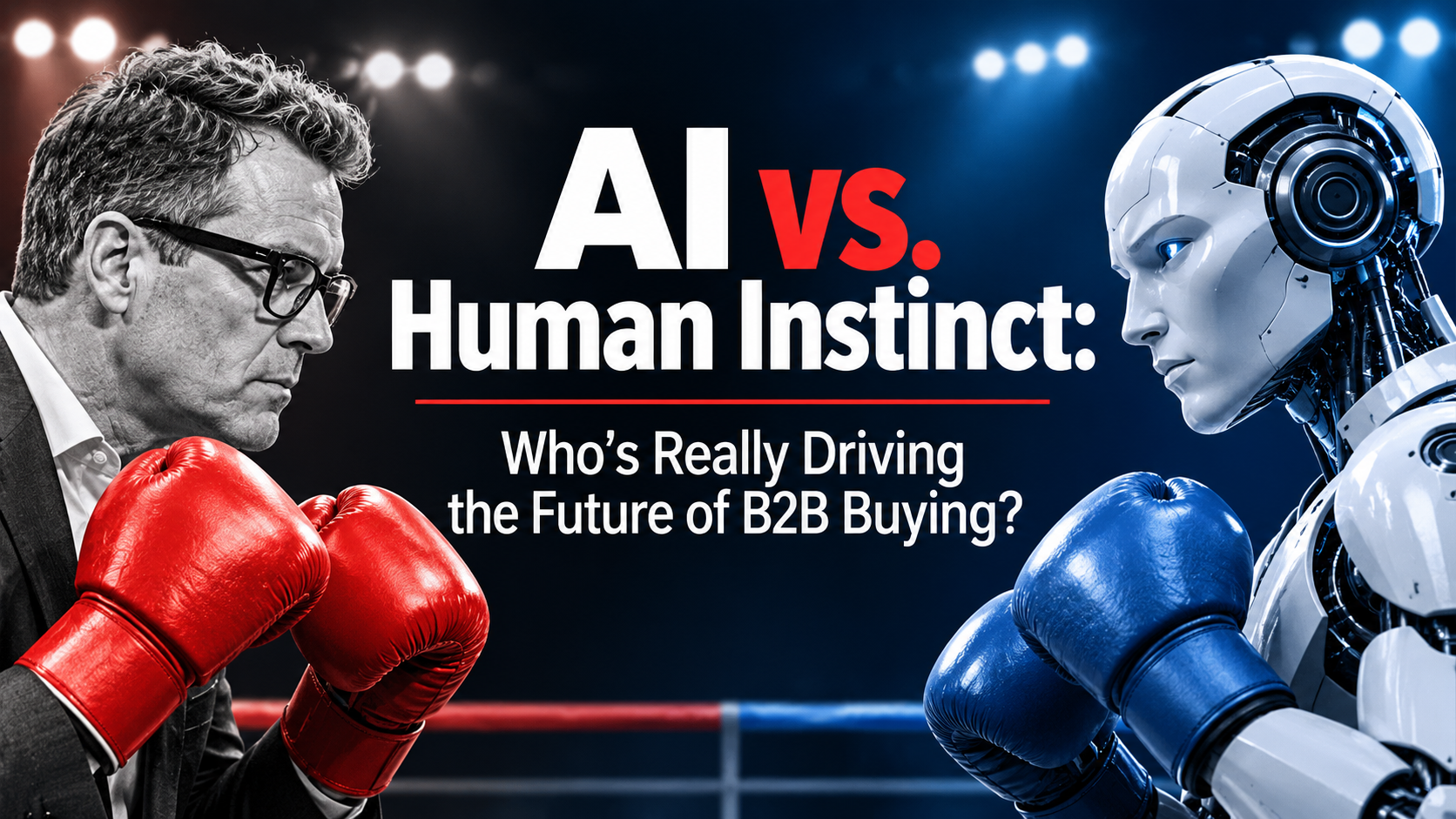
AI vs. Human Instinct: Who’s Really Driving the Future of B2B Buying?
By: Ben Webb
There was a heavyweight marketing bout at The Drum’s B2B WorldFest in Miami Nov 9-10th between two gurus who pulled no punches trying to answer the big question: has AI changed the customer or has it simply changed how they make decisions?
Mark Ritson – a sharp-tongued and relatively old-school Brit and columnist who has spent more than 25 years teaching at London Business School, MIT Sloan School of Management and the University of Minnesota – was on the side of the humans. Tom Goodwin– a four-time #1 Voice in Marketing on LinkedIn with 725,000 followers and a pragmatic futurist with an interest in empowering businesses to embrace new technologies in marketing – backed the algorithms.
Round 1: Has the customer actually changed?
Ritson’s opening salvo was to say the impact of technological change – including the much touted drop in attention spans – was exaggerated. AI is different to what has gone before but the consumer remains the same. Despite the shock of Covid, for example, consumer behavior soon returned to normal. Change is not evolutionary possible in such a short time. “We are seeing new infrastructure,” he said. “We are seeing new technology. These are new pipes, but through those pipes are flowing the same water that has always flown, with the same basic decision-making.”
Goodwin ducked and shot back with the idea that technological advances have changed everything, including the commercial environment. Technology itself is interacting in new ways. “Code is writing code,” he jabbed. Consumers – confused by what is happening and all the mind-boggling choices they have to make – are desperately clutching at technology to provide help. A virtual shopping agent, for example. “We are living in a world of exponential change,” he said. “People are overwhelmed. They are scared..”
Round 2: Will AI make traditional brand building irrelevant?
Now on the front foot Goodwin claimed that increasingly influential algorithms are now driving buying decisions. So old school storytelling and building emotional connections with consumers is less relevant“The world is about to change,” he warned, especially as product quality is rising and often making competitor products tough to tell apart. “We absolutely need to reorchestrate and rethink marketing and we need to rethink the technologies that we use because it’s not going to be people making these decisions. It’s going to be algorithms.”
Ritson took it on the chin. He admitted a third of consumers preferred AI recommendations to advice from friends or family but said this did not equate to a fundamental change in human behavior. Twas ever thus. Consumers have always liked advice and shortcuts. AI’s just another tool that saves time and mental energy. Everyone’s busy. “All of us are what we call cognitive misers,” he said, “and have more important things to worry about.”
Round 3: Will brand loyalty survive AI?
At the beginning of the third round the pair traded punchy stats. Ritson said AI can boost loyalty by almost a third, according to the SAP Customer Loyalty Index. Goodwin hit back with alternative research that revealed 69% of B2B buyers would switch suppliers if an AI agent identified a better alternative. Ritson defended well, pointing out what customers say they will do and what they actually do can be very different. Behavioral evidence remains more important than stated intentions. “Loyalty does exist and loyalty is a powerful financial force for most brands,” Ritson added.
“A [marketing] concept like brand loyalty doesn’t exist,” countered Goodwin. “I’m not loyal to American Airlines. I just happen to fly with them a lot and they give me miles in return.” In other words the relationship between brand and consumers is far more about the nuts and bolts of each buying decision – convenience, habit and financial incentives like promos. Interestingly this means AI can be seriously beneficial as it can replace habitual preferences that do not maximize value with ones that do. Similarly, he said AI could bring robust decision-making in the B2B space where minimizing risk often trumps maximizing value. With one well-aimed salvo he added: “Each and every single one of you in a B2B industry will be able to make whatever decision you want as long as that AI is behind you.”
Round 4: Are today’s businesses prepared for AI-powered customers?
Appearing to hang up their gloves, both Goodwin and Ritson agreed business has to be brave in the new world of AI. Ritson feared that AI could even lead to a widening of the gap that lies between customer expectations and company delivery. He explained: “What’s happening is the customer is using AI way better than you are and way more efficiently to get to know more and have higher expectations.”
And the winner was – judged by the competitor who received the loudest cheer – both of them. The bout was declared a draw. Goodwin summed it up. “Isn’t the final answer that the truth is sort of halfway between the two and the answer to everything in marketing is ‘it depends’?” Or, as Ritson might put it, the rise of Bothism– as discussed on these pages a while ago – means both things can be true.